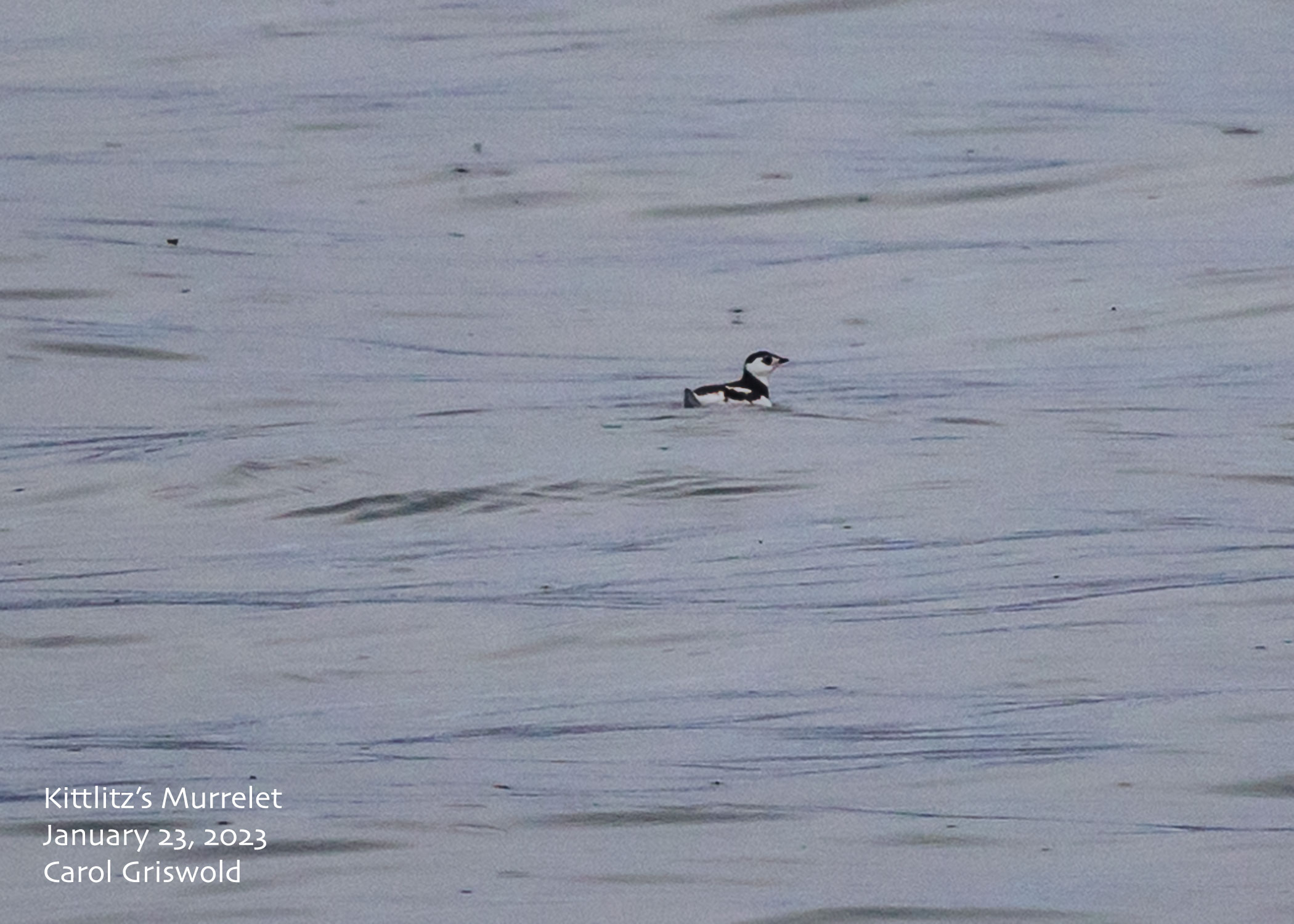
Tuesday, January 24, 2023 Kittlitz’s Murrelet!

Seward, Alaska

Sunrise (is there a sun?) 9:31 am, sunset 4:50 pm for a total daylength of 7 hours and 19 minutes. Tomorrow will be 4 minutes and 36 seconds longer. Cloudy with occasional light sprinkles, temps in the mid 30s, and mostly calm. Freezing rain turned everything not covered with crusty snow into a hazardous skating rink; ice creepers are limb-savers. 

Yesterday, around 4:30 pm in the increasingly dim light, visiting birder Ben Lagasse reported a KITTLITZ’S MURRELET feeding offshore from the inactive fish processing plant near the Lowell Creek outfall.

On this monochrome day, even at noon, the gray sky merged seamlessly into the pewter bay, and light rain spattered on optics. As the news spread, local birders Robin C, Sam D, and Jenna S apparated to join my search at the outfall, armed with scopes. 

About 50 black PELAGIC CORMORANTS gathered in front, diving for bait fish; one long, slender fish looked like a sand lance. A drake LONG-TAILED DUCK, WHITE-WINGED SCOTERS, SURF SCOTERS, BARROW’S GOLDENEYES, COMMON MERGANSERS, RED-BREASTED MERGANSERS, a RED-NECKED GREBE, a few SHORT-BILLED GULLS and GLAUCOUS-WINGED GULLS also paddled and dove nearby. One female White-winged Scoter popped up with a clam, struggling with it before finally choking it down. All great birds and wonderful sightings, except we wanted the unusual alcid.

Sprinkled farther out, dozens of tiny black and white MARBLED MURRELETS called to each other, their voices carrying far across the water. But no Kittlitz’s. Sam spotted more alcids by the Alaska Sealife Center to the north, so we converged in the parking lot. Nope, just MAMUs. It was remarkable to see and hear so many Marbled Murrelets. Finally, I split off, heading for home. Of course, almost immediately, Sam found the Kittlitz’s by the Founder’s Monument and I raced back.

There, far off, a speck in the gray ocean, was the Bird. The difference was immediately obvious, so much white: on the face, leaving the dark eye like an island, white throat, and undersides. A nearly complete dark broad neck band/collar swept down like a scarf on either side but did not close over the white throat. Even the bill looked smaller when scrutinized through the scope; the species name “brevirostris” means “short-billed”. Non-breeding plumage is much easier than breeding plumage!

It’s a mystery why this Kittlitz’s was so far up in the bay, a bird closely associated with glacial talus slopes in breeding season and rarely seen far from remote tidewater glaciers in Kenai Fjords National Park. Hopefully, it will continue to find forage fish just offshore so other birders can enjoy this rare sighting from Seward’s shore.

Now to find that Red-faced Cormorant Ben reported...

Update: Sam reported this this is only the fourth record on eBird in January anywhere and the first for the Kenai Peninsula. San rebound the KIMU on January 28.

Happy Birding!
Carol Griswold
Seward Sporadic Bird Report Reporter


Monday, January 23, 2023 Marine Amphipods


Seward, Alaska

Another gray, cloudy faux-winter day with light rain, temps in the 30s. 

Last month, on December 23, the highest tide of the year reached 13.6’, a respectable height for Seward. This week, the daylight tides steadily climbed from a 12-footer on Thursday morning to 13.4’ on Sunday afternoon, shrinking area beaches to little or nothing and limiting access.

At 2 pm today, high tide 13.0’, Fourth of July beach seethed and surged with incoming fingers of curling waves. They hissed through the bedraggled beach rye grass and licked the remaining crusty snow before sliding back, leaving a curtain of lacy foam.

Just ahead of me, I noticed little dark stones, flung by the waves onto the snow and sand. Many of them. I looked closer and discovered to my amazement that they were marine amphipods, larger than the usual “beach shrimp” at up to an inch long. 

Most were dark, but a few were tan. After recovering from the shock of being torn from under their nearby intertidal rock homes, they crawled along the unfamiliar snowy landscape in an alien world, seeking shelter from the chilly weather and exposure.

Some, more adventurous (or anxious), curled their abdominal plates underneath and quickly snapped them straight, launching them forward up to 8” or even a foot. It was quite impressive!

I found an abandoned clam shell and scooped up a dozen at a time; they immediately curled into a protective ball that reminded me of fern fiddleheads. As the waves receded, I dashed down, lifted a rock, dumped out the precious cargo and carefully replaced the roof, hoping they might burrow to safety before the next sucking surge. It was hopeless to save them all; dozens more crawled and hopped all around me.

I was surprised that the normally watchful gulls and ravens or other birds had not noticed this surprising feast delivered by the waves. Such tasty protein, substantial servings, and plentiful.

When returned the next day, all was quiet, the secretive intertidal life once again invisible to this human’s eye. I appreciate what that powerful high tide revealed to me; so interesting!

Update: According to "Common Sea Life of Southeastern Alaska, a Field Guide by Aaron Baldwin and Paul Norwood," the beach hoppers I found could be the Common Beach Hopper, aka Splash Zone Beach Hopper (well named) possibly Traskorchestia traskiana. Although described at 2 mm, the Oregon Institute of Marine Biology says 20 mm is possible, about the size I estimated. 

However, as there are over 700 representatives in Alaska alone, are extremely difficult to identify in the field and often require dissection, I won't know for sure. Still, it's fun to learn about them. Who knew that amphipod females have a little pouch called a marsupium to brood the eggs and shelter the juveniles. Amazing world!

The field guide could be a menu for birds dining at the beach.

https://www.naturebob.com/sites/default/files/Aaron%20Baldwin%20Sealife%20of%20SE%20Alaska%2008-15-15.pdf


Happy Birding!
Carol Griswold
Seward Sporadic Bird Report Reporter


Thursday, December 29, 2022 Count Week Day 2: Short-eared Owl

Seward, Alaska

Sunrise 10:03 am, sunset 3: 58 pm for a total day length of 5 hours and 55 minutes. Tomorrow will be 1 minute and 28 seconds LONGER. 

After a week of piercing cold mixed with strong north winds, the past few overcast days seemed balmy, hovering around freezing and calm. Roads remain icy and treacherous. The National Weather Service issued a Special Weather Alert for this weekend as another series of storms is predicted to hit South-central this weekend.

Equipped with ice grippers that will likely stay on until May, I checked out the tidelands for the afternoon walk. Chaotic blocks of ice piled up in the estuary pond, leaving several areas of open water where MALLARDS and a few GADWALL paddled and dabbled, and BUFFLEHEAD dove. 

I found the ROCK SANDPIPER flock with DUNLINS feeding intently at the receding tide’s edge. About 50 Gulls, likely Short-billed and Glaucous-winged (too far without a scope), rested on the flats. The fierce cry of an adult BALD EAGLE rang out from its perch at the very top of a tall red crane in the adjacent industrial area to the west.

Suddenly, I heard an odd, almost muffled honking and turned to find an adult TRUMPETER SWAN flying from the east to an open area of the pond. It soon settled down to feed among the ducks. What a relief to have access to food after that cold spell!

Then, to my joy, I spotted a SHORT-EARED OWL wafting over the tide-washed sedges, hunting for unsuspecting voles. A RAVEN took time out of its busy schedule to harass it, so the Owl kept moving and was soon out of my sight.

The Seward Christmas Bird Count is on Saturday; I invited all these birds to participate and bring their friends.

Happy Birding!
Carol Griswold
Seward Sporadic Bird Report Reporter


Friday, December 16, 2022 Swans, Red Crossbills, and Bohemian Waxwings

Seward, Alaska

Sunrise 9:58 am, sunset 3:51 pm for a total day length of 5 hours and 52 minutes. Tomorrow will be 0 minutes and 53 seconds shorter.

Sunny today for that short time, low of 16 to a high of 23, with a brisk north wind gusting to 21 mph like a fan in a freezer. Continued cold, clear, and windy in the forecast.

Hoping to beach it out of the wind, I headed to Afognak Beach. On Tuesday, I counted 33 TRUMPETER SWANS, including 2 cygnets that were still quite brown, feeding on eel grass in the bay. Today, there were none. I kept walking along the frozen ocean floor, crackling through thin ice sheets, to the Point. In the distance on the tide flats in the sun, sixteen sleeping Swans lay in a line with heads tucked under wings like rounded snow drifts, completely exposed to the cold north wind.

The sluggish sun slowly crept over the nearby mountains and the blue shadows along the shore shrank back, but the Swans remained, fast asleep. I wondered how long they had been there; the 8.86’ high tide at 7:12 am likely covered this area. Did they paddle out of the adjacent stream to rest as the tide ebbed?

As I waited for some action, seven RED CROSSBILLS sailed in and landed on a spruce, extracting tiny seeds from the cones, chattering quietly. When I left, the Swans were still sleeping. Conserving energy? Fasting? Do they feed in the dark?

Robin C reported six Trumpeter Swans feeding at the north end of the Lagoon around 2 pm, so at least some Swans were active.

Back home, I was excited to hear the soft chirring of BOHEMIAN WAXWINGS and found about 40 decorating a neighbor’s spruce like feathered ornaments. After a few minutes, they simultaneously erupted and vanished. Maybe that Sharp-shinned Hawk Robin C reported in the ‘hood on Tuesday cruised past, checking out the lunch menu.

Happy Birding!
Carol Griswold
Seward Sporadic Bird Report Reporter


Monday, December 12, 2022 Snow Birds

Seward, Alaska

Sunrise, a leisurely 9:53 am, sunset 3:52, for a total day length of 5 hours and 36 minutes. Tomorrow will be 1 minute and 36 seconds shorter as we approach the Winter Solstice next week on December 21.

Mostly sunny for those precious daylight hours after several dark, stormy days. Schools, including Seward, were closed across South Central today, mostly due to impassable roads. Town only received about 8-10 inches of crusty snow, whereas farther north, the storm dumped several feet. The fierce NNW wind boiled and blew snow off the surrounding mountains, 13-16 mph with gusts to 38. Fortunately, the temp rose from a low of 14 to 34 by midday, taking out the sting.

I crunched through billows of crusty snow to the beach, pushed enthusiastically by the wind. Suddenly, a flock of about 20 SNOW BUNTINGS swirled past like snow flurries. They landed in the snow, pecking at loose ryegrass seeds as they strode into the wind, then flew a short way to glean more seeds from protruding stalks. After a minute, off they blew, out of sight.

I marched on, escaping to the snow-free, tide-washed beach. A single DUNLIN poked and probed along the tide’s edge near four SHORT-BILLED GULLS. I searched for the usual winter flock of Rock Sandpipers without success. Small rafts of ducks surfed in the waves, mostly MALLARDS with a few BUFFLEHEAD.

On my return, I heard the sonorous honking of TRUMPETER SWANS. I spun around and followed them, stroking into the wind, veering towards the rugged, snowy mountains until they disappeared, white into white.

A shaft of sunshine, a surprise of snow birds, snow streamers and spectacular scenery: a sweet Seward song. 

Happy Birding!
Carol Griswold
Seward Sporadic Bird Report Reporter


Wednesday, November 9, 2022 American Coot, and Eurasian Brambling!

Seward, Alaska

Cloudy, mostly calm, scattered showers, temps in the low 30s. Fresh snow on the mountains but not in town.

Thanks to Robin Collman, I was fortunate to see the AMERICAN COOT that he spotted yesterday, and a BRAMBLING that he found this afternoon.

The last report I have on a Coot is from last year on October 18, 2021 at Bear Lake, also first reported by Robin. It didn’t stay long. Today’s bird lingered in a tide-flooding finger of what locals call “Bufflehead Creek” at the Airport estuary after the more wary Bufflehead pair shot off. We only caught brief glimpses as it paddled behind the beach rye grass lining the banks, but the whitish-billed, dark-bodied member of the Rail family is very distinctive.

A Brambling was last seen at the December 19, 2020 Seward Christmas Bird Count with Juncos on Marathon Blvd behind Safeway. Today’s Eurasian bird favored the company of at least dozen ROBINS and VARIED THRUSHES dining on Mt Ash berries in the 200-block of Second Ave. They flew back and forth between tall and dense spruce and the tangled branches of the Mt Ashes.

A pesky STELLER’S JAY and nosy BLACK-BILLED MAGPIE harassed all the birds, making them spooky and hard to find. The Brambling was notably smaller than the chunky thrushes, but bigger than the stub-tailed RED-BREASTED NUTHATCH working the tree trunks. Two SONG SPARROWS called from a nearby fence line, staking out their territories.

Birds once again dazzled a few lucky birders and brightened a dim, rain-speckled day.

Happy Birding!
Carol Griswold
Seward Sporadic Bird Report Reporter


Tuesday, November 1, 2022 Rock Sandpipers and Swan tragedy

Seward, Alaska

Sunrise 9:22 am, sunset 6:03 pm for a total day length of 8 hours and 41 minutes. Tomorrow will be 5 minutes and 11 seconds shorter.

After being blasted by the north wind and for the past week with gusts to 40 mph, a new low brought diminished winds (a mere 3-11 mph with gusts to 26) and sunshine for a welcome break mid-day. Then, as temps rose from the teens to 30º, came the calm before the storm as the wind shifted to the south, with a forecast for rain and a “wintry mix.” 

I breezed out to the tidelands during that lucky break and found frozen jellies washed up on the beach, including the mini-suns of Northern Sea Nettles, a slurry of Lion’s Mane, and glass-clear Water Jellies. What a curiosity to find these once fluid and graceful animals now stilled and stiff enough to hold like fanciful confections.

Bits of wind-blown rockweed etched perfect concentric circles in the firm sand around their unreliable storm-tossed rock anchors. The capricious wind enjoyed tossing anything movable and played with whatever remained.

As the tide ebbed to just the right distance, 28 ROCK SANDPIPERS and one or two DUNLIN fluttered in to start feeding, chittering and chattering. Their number had increased since I last saw them. They fed and flew, returning again to the same spot. So fine to see these hardy shorebirds likely to overwinter here on the shore of Resurrection Bay.

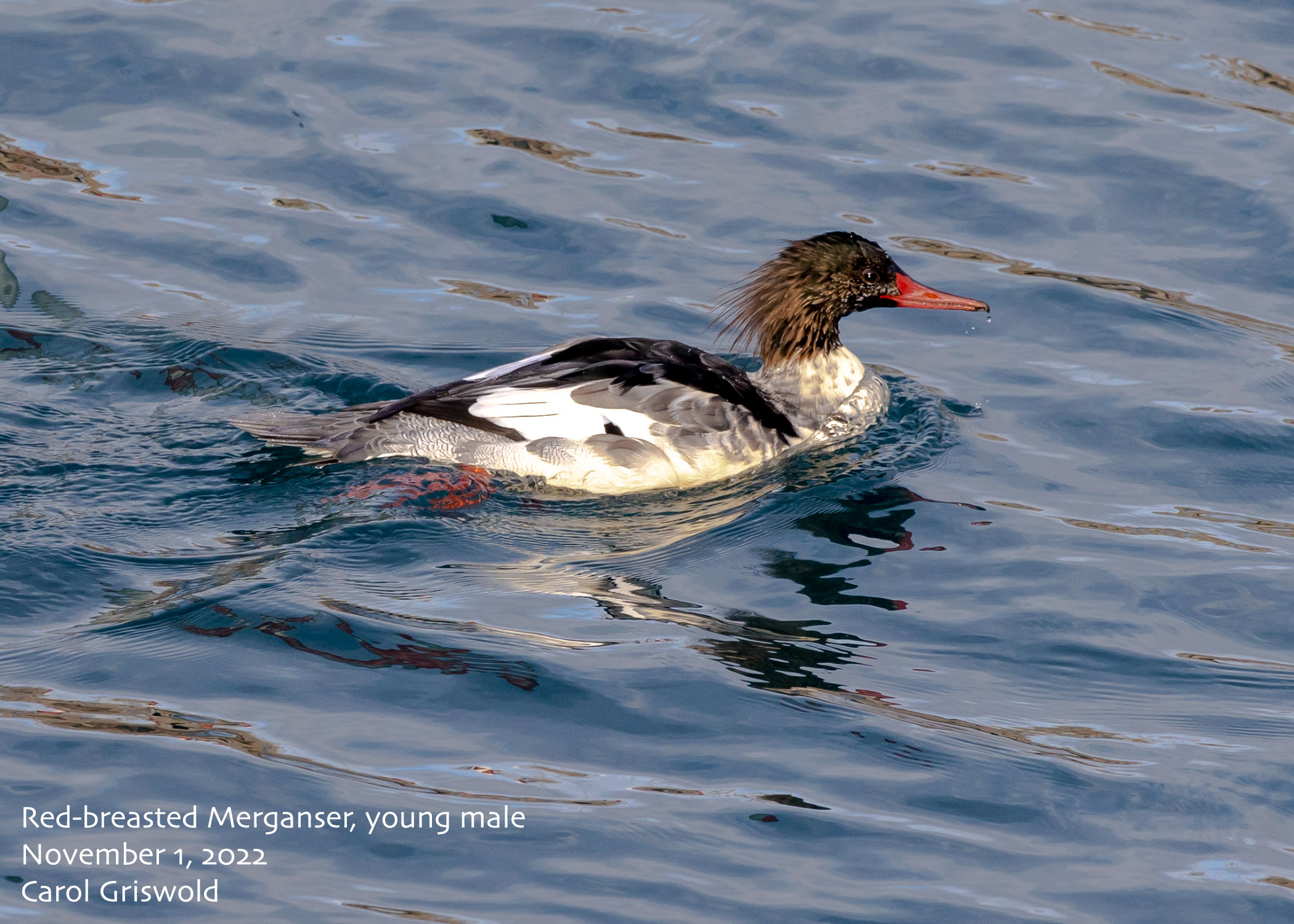
On the way home, I swung by the harbor and found two young male RED-BREASTED MERGANSERS snorkeling along the docks, their unkempt crests almost flattened. 

The lovely day dissolved when I received a call of distress near dusk at 4:50 pm: two adult TRUMPETER SWANS had flown from Preacher Pond, near the intersection of the highway and Nash Road, in a direct line to Bear Lake. 

One Swan missed the numerous and unmarked lines strung like piano wire between the power poles but the other hit the almost invisible lines and fell like a rock to its death in the driveway to a local business near the pond.

I advised the caller to call the Alaska Sealife Center and the wildlife rescue responders collected the 25-pound Swan before I arrived. How sad to see a few beautiful white feathers on the cold, hard ground under the wires!  

Another preventable tragedy occurred on October 19th when a 4-month old cygnet hit the lines near its birthplace at the Mile 1 Nash Road wetlands, one of the five babies. 

All these hazardous wires surrounding swan habitat and flight corridors should be festooned with bird deflectors, or better, buried. The buried lines along the Lagoon in town are a wonderful success story and example. Sorry for the sad news.

Happy Birding!
Carol Griswold
Seward Sporadic Bird Report Reporter