Monday, February 20, 2023 Moose on snowbank, Double-crested Cormorant, Western Screech Owls

Seward, Alaska

Sunny and windy as forecasted. Low of 19, high of 27. North wind 5-12 mph with gusts up to 30 mph. Out of the wind the sun felt wonderfully warm. Step away from the windbreak and it was cold! Powdery snow blew off the surrounding mountains creating swirling summit clouds.

While birding with friends from out of town, I drove around a curve and suddenly was looking up at a giant moose standing on a snowbank ramp, reaching for Mt Ash twigs. Up so high, she seemed even more enormous. 

I snatched up my camera and clicked away as she stretched even higher. I don’t often get the chance to safely see the white chin of a moose or the underside. Or note her lovely eyelashes and the many beautiful shades of brown in her living fur coat.

Another moose grazed below on the other side of the snowbank but I didn’t linger. In a minute I was gone, simply amazed by this closeup sighting of another iconic Alaskan mammal.

Of note, a DOUBLE-CRESTED CORMORANT, likely immature, roosting with two pencil-billed PELAGIC CORMORANTS by the seafood processing plant at SMIC. A dozen other Pelagic Cormorants preened and paddled in the boat basin.

Also spotted, the usual BARROW’S GOLDENEYES, HARLEQUIN DUCKS, COMMON MERGANSERS, SURF SCOTERS, SHORT-BILLED GULLS, GLAUCOUS-WINGED GULLS, AMERICAN CROWS, COMMON RAVENS, BLACK-BILLED MAGPIES, PIGEONS. Yesterday in addition, I saw the continuing drake LONG-TAILED DUCK and MARBLED MURRELETS by the Lowell Point Road seafood processing plant, but did not check today. Too windy!

Although I have been listening hard, I have not yet heard my neighborhood Saw-whet Owls or Great Horned Owls. However, on Thursday night around 8:30 pm, Robin and Sam heard a pair of Western Screech Owls hooting and hunting at Old Exit Glacier Road.

Happy Birding!
Carol Griswold
Seward Sporadic Bird Report Reporter


Sunday, February 19, 2023 Sea Otter on Snow

Seward, Alaska

Sunrise 8:26 am, sunset 5:59 pm, for a total daylength of NINE hours and 32 minutes. Tomorrow will be 5 minutes and 25 seconds longer.

Waxing new moon, high tides.

Bright sunshine on fresh snow, with an overnight low of 21 and daytime high of 29. North wind 6-9 mph with gusts to 23 made it feel cooler. Monday forecast for sunny and windier with snow showers mid-week.

Not many birds at the boat harbor today; mostly American Crows eating melting snow on the floats, and a few BARROW’S GOLDENEYES paddling away. However, a Sea Otter proved very entertaining and let me watch it take a vigorous bath.  

As flexible and fluid as water, he continuously rolled front to back, back to front, and side-to-side. Deft little paws like hands scrubbed every inch of fur (600,000-1,000,000 hairs, but who’s counting?) from tail to head and behind the ears. After several minutes, he dove and swam right underneath the dock where I was watching, and popped up in the next bay.

Now swimming on his back, he headed for another float between empty boat slips and, with a bit of effort, heaved himself up onto the snow. There he continued to preen and fluff that gleaming, luxurious fur coat in the sunshine, oblivious to the sharp wind. Even the wide back feet got into the act.

The extensive silvery-white fur cape extending down his face, head, and neck and his large size made me think he’s an old sea otter, but with the flexibility of a youngster. He’s probably a tour boat favorite in the summer, patiently posing and looking absolutely adorable as eager tourists lean over the side to snap his photo, just like me. 

I thanked him for letting me watch, then left him in peace and strolled away. 

Happy Birding!
Carol Griswold
Seward Sporadic Bird Report Reporter


Sunday, February 12, 2023 ASLC Eiders et al

Seward, Alaska

Sunrise 8:46 am, sunset 5:40 pm for a total daylength of 8 hours and 54 minutes. Tomorrow will be 5 minutes and 19 seconds longer. The days are growing noticeably longer, especially on sunny days.

Partly sunny today (yay!); temperature dropped from an overnight high of 29 to a low of 16, offset by a NNW wind around 12 mph increasing to howling with frequent gusts up to 34 mph. The bay remains warmer at 45ยบ. Forecast for tomorrow is cooler, sunnier, and windier, then back to snow and snow showers for the rest of the week. 

Seward received a 17” blanket of lovely snow on Friday, sifting down and swirling around like a snow globe, light enough to easily shovel between dumps. Now it’s just blowing around, stinging, and drifting up.

Finding few birds on my stroll/blow about town, I decided to get my bird fix at the Alaska Sealife Center. Fortunately, access was open to the aviary despite the strong winds, where amazing and gorgeous sea birds were close enough to see eyeball to eyeball.

The KING EIDER and SPECTACLED EIDER drakes in full breeding glory, vied for best of show with exotic combinations of colors. Their more demure yet classy hens, clad in hues of brown with subtle patterning and a dark blue-gray bill that sometimes beamed bright blue, accompanied them with justifiable pride. 

Easily missed, a pair of first-year STELLER’S EIDERS, hatched in May 2022, joined the aviary a few months ago. The young male is molting into a more mature look with white feathers splotching the brown. The dark brown female sported a long blue-gray bill and a glimmer of a blue speculum for dash. This is the smallest Eider species, only slightly larger than the nearby HARLEQUIN DUCKS.

How fantastic to watch three of the four Eider species on this blustery day! The only one missing is the largest, the Common Eider.

RHINOCEROS AUKLETS’ whiskers tangled in the wind, and sometimes the birds blew backwards in the gusts. A row of TUFTED PUFFINS, still far from breeding finery, paddled furiously against the aquarium glass, perhaps enjoying the reflections. One posed comically, as they do, watching me with warm brown eyes. The HORNED PUFFINS, were even further from changing, some still in the process of shedding their old bill plates.

The drake SMEW was elegant in black and white, especially when he raised his crest, surprised by a gust. His lady napped unconcerned, head tucked under wing, not interested in this paparazza.

High above on the cliffs perched the RED-LEGGED KITTIWAKES, enjoying the sunshine peeking over the enclosure walls. Occasionally one or two dashed overhead for a quick fly-about.

COMMON MURRES flocked and preened together, still wary of people. Shrill PIGEON GUILLEMOTS huddled on the rocks. HARLEQUINS paddled along the far side, not nearly as curious and friendly as the Eiders and Auklets.

After a while, my fingers growing cold, I reluctantly left to enjoy the many wonders awaiting in the other habitats. What a spectacular and marvelous watery world, so close and yet so mysterious!

Happy Birding!
Carol Griswold
Seward Sporadic Bird Report Reporter


Tuesday, January 24, 2023 Kittlitz’s Murrelet!

Seward, Alaska

Sunrise (is there a sun?) 9:31 am, sunset 4:50 pm for a total daylength of 7 hours and 19 minutes. Tomorrow will be 4 minutes and 36 seconds longer. Cloudy with occasional light sprinkles, temps in the mid 30s, and mostly calm. Freezing rain turned everything not covered with crusty snow into a hazardous skating rink; ice creepers are limb-savers. 

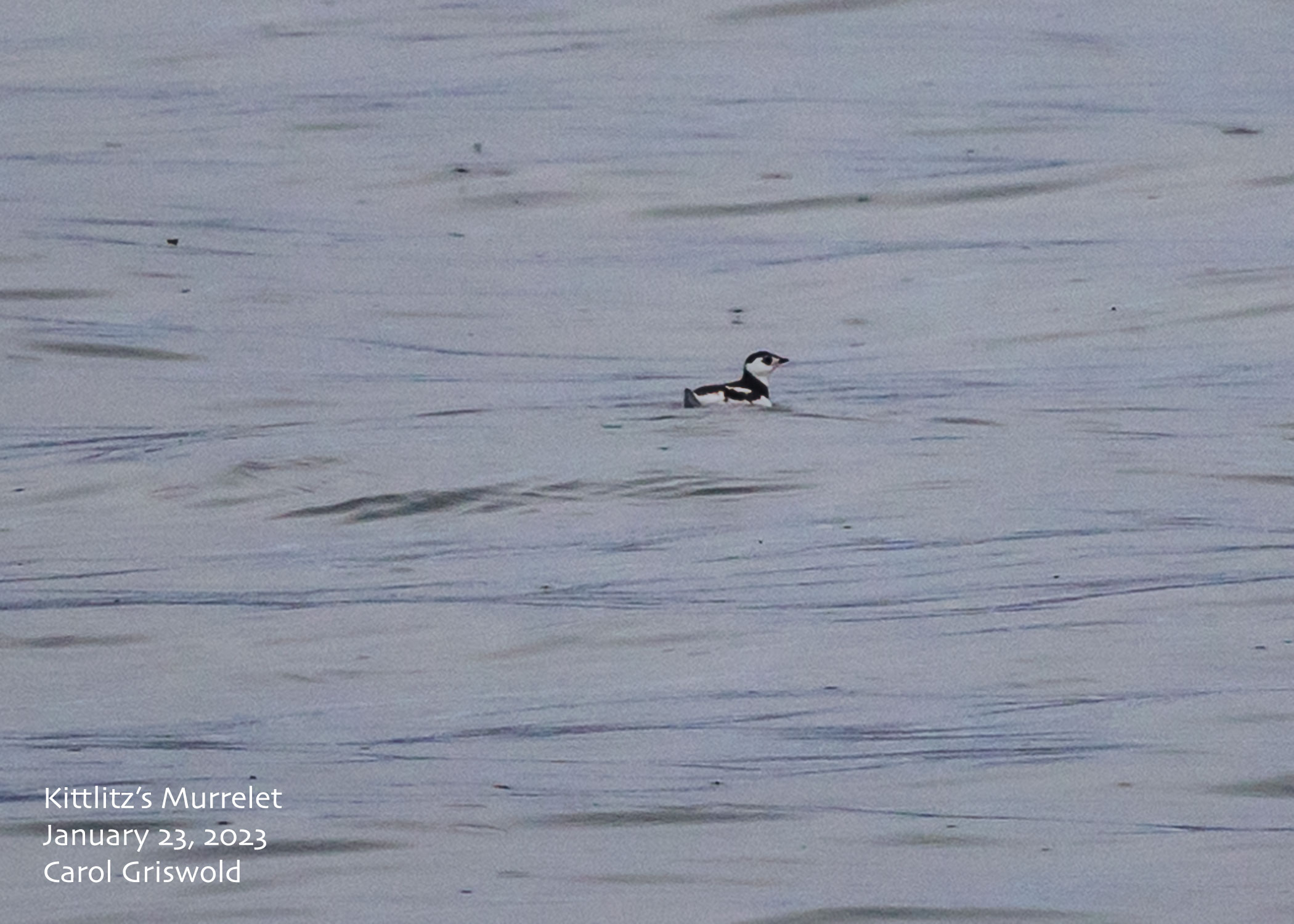
Yesterday, around 4:30 pm in the increasingly dim light, visiting birder Ben Lagasse reported a KITTLITZ’S MURRELET feeding offshore from the inactive fish processing plant near the Lowell Creek outfall.

On this monochrome day, even at noon, the gray sky merged seamlessly into the pewter bay, and light rain spattered on optics. As the news spread, local birders Robin C, Sam D, and Jenna S apparated to join my search at the outfall, armed with scopes. 

About 50 black PELAGIC CORMORANTS gathered in front, diving for bait fish; one long, slender fish looked like a sand lance. A drake LONG-TAILED DUCK, WHITE-WINGED SCOTERS, SURF SCOTERS, BARROW’S GOLDENEYES, COMMON MERGANSERS, RED-BREASTED MERGANSERS, a RED-NECKED GREBE, a few SHORT-BILLED GULLS and GLAUCOUS-WINGED GULLS also paddled and dove nearby. One female White-winged Scoter popped up with a clam, struggling with it before finally choking it down. All great birds and wonderful sightings, except we wanted the unusual alcid.

Sprinkled farther out, dozens of tiny black and white MARBLED MURRELETS called to each other, their voices carrying far across the water. But no Kittlitz’s. Sam spotted more alcids by the Alaska Sealife Center to the north, so we converged in the parking lot. Nope, just MAMUs. It was remarkable to see and hear so many Marbled Murrelets. Finally, I split off, heading for home. Of course, almost immediately, Sam found the Kittlitz’s by the Founder’s Monument and I raced back.

There, far off, a speck in the gray ocean, was the Bird. The difference was immediately obvious, so much white: on the face, leaving the dark eye like an island, white throat, and undersides. A nearly complete dark broad neck band/collar swept down like a scarf on either side but did not close over the white throat. Even the bill looked smaller when scrutinized through the scope; the species name “brevirostris” means “short-billed”. Non-breeding plumage is much easier than breeding plumage!

It’s a mystery why this Kittlitz’s was so far up in the bay, a bird closely associated with glacial talus slopes in breeding season and rarely seen far from remote tidewater glaciers in Kenai Fjords National Park. Hopefully, it will continue to find forage fish just offshore so other birders can enjoy this rare sighting from Seward’s shore.

Now to find that Red-faced Cormorant Ben reported...

Update: Sam reported this this is only the fourth record on eBird in January anywhere and the first for the Kenai Peninsula. San rebound the KIMU on January 28.

Happy Birding!
Carol Griswold
Seward Sporadic Bird Report Reporter


Monday, January 23, 2023 Marine Amphipods


Seward, Alaska

Another gray, cloudy faux-winter day with light rain, temps in the 30s. 

Last month, on December 23, the highest tide of the year reached 13.6’, a respectable height for Seward. This week, the daylight tides steadily climbed from a 12-footer on Thursday morning to 13.4’ on Sunday afternoon, shrinking area beaches to little or nothing and limiting access.

At 2 pm today, high tide 13.0’, Fourth of July beach seethed and surged with incoming fingers of curling waves. They hissed through the bedraggled beach rye grass and licked the remaining crusty snow before sliding back, leaving a curtain of lacy foam.

Just ahead of me, I noticed little dark stones, flung by the waves onto the snow and sand. Many of them. I looked closer and discovered to my amazement that they were marine amphipods, larger than the usual “beach shrimp” at up to an inch long. 

Most were dark, but a few were tan. After recovering from the shock of being torn from under their nearby intertidal rock homes, they crawled along the unfamiliar snowy landscape in an alien world, seeking shelter from the chilly weather and exposure.

Some, more adventurous (or anxious), curled their abdominal plates underneath and quickly snapped them straight, launching them forward up to 8” or even a foot. It was quite impressive!

I found an abandoned clam shell and scooped up a dozen at a time; they immediately curled into a protective ball that reminded me of fern fiddleheads. As the waves receded, I dashed down, lifted a rock, dumped out the precious cargo and carefully replaced the roof, hoping they might burrow to safety before the next sucking surge. It was hopeless to save them all; dozens more crawled and hopped all around me.

I was surprised that the normally watchful gulls and ravens or other birds had not noticed this surprising feast delivered by the waves. Such tasty protein, substantial servings, and plentiful.

When returned the next day, all was quiet, the secretive intertidal life once again invisible to this human’s eye. I appreciate what that powerful high tide revealed to me; so interesting!

Update: According to "Common Sea Life of Southeastern Alaska, a Field Guide by Aaron Baldwin and Paul Norwood," the beach hoppers I found could be the Common Beach Hopper, aka Splash Zone Beach Hopper (well named) possibly Traskorchestia traskiana. Although described at 2 mm, the Oregon Institute of Marine Biology says 20 mm is possible, about the size I estimated. 

However, as there are over 700 representatives in Alaska alone, are extremely difficult to identify in the field and often require dissection, I won't know for sure. Still, it's fun to learn about them. Who knew that amphipod females have a little pouch called a marsupium to brood the eggs and shelter the juveniles. Amazing world!

The field guide could be a menu for birds dining at the beach.

https://www.naturebob.com/sites/default/files/Aaron%20Baldwin%20Sealife%20of%20SE%20Alaska%2008-15-15.pdf


Happy Birding!
Carol Griswold
Seward Sporadic Bird Report Reporter