Sunday, September 8, 2019 Salmon-eating Swans


Seward, Alaska

Sunrise 7:10 am, sunset 8:43 pm for a total day length of 13 hours and 33 minutes. Tomorrow will be 5 minutes and 24 seconds shorter.

High today in the low 60s, low in the mid 40s. Continuing rain in the forecast for the next 10 days, making up for the drought this summer. It won’t resurrect the dead trees, shrubs, and forbs, but half-dead plants seem to be reviving. Rain is the color green!

I tuned into the continual Nature show at the Lagoon this afternoon. Eight splendid adult TRUMPETER SWANS napped at north end. I assume six are last year’s resident cygnets, now 15 months old, plus two extras, also possibly older residents. 

A surprise adult GREAT BLUE HERON, normally so shy and secretive, fished in the nearby water and walked among them. Two DOUBLE-CRESTED CORMORANTS dove for fish in deeper water. A DIPPER sailed past heading for the culvert and feeder creek. Pink salmon and one very old king salmon splashed, spawned, and swam up the creeks.

After a time, the Swans began preening and stretching. Suddenly, three RIVER OTTERS rolled into view and stirred up everyone. They bounced up onto shore, displacing the Great Blue Heron who flew up and landed behind them. The Swans, alert now, watched warily. The Otters instantly evaluated the risk of the eight powerful bills and 16 strong wings, and wisely flowed back into the water, disappearing as quickly as they came.

Wide-awake, some of the Swans slowly and majestically waded into the water. I was amazed to watch one Swan reach down and repeatedly pull up a salmon carcass, grabbing bits of the loose skin and soft flesh before it sank again. Several times, it grabbed enough of the salmon to shake it vigorously, bits flying, then resumed eating. 

Two, then three Swans paddled up the little creek, long necks looping down, sucking up salmon eggs like vacuum cleaners. A Mallard loitered behind, gobbling down more salmon eggs. Live salmon swam past, intent on completing their mission of spawning, their bounty and bodies unintentionally providing nourishment for many food webs.

The two outlier Swans paddled off. After more stretching, preening, and egg gobbling, the six followed, leaving the Great Blue Heron in peace. I looked forward to watching it fish, but suddenly it took off, cleared the highway, aiming for the head of the bay.

I know the show continued with many variations and cameos and I hated to leave my favorite channel, but my time was up.

Happy Birding!
Carol Griswold
Seward Sporadic Bird Report Reporter
Seward, Alaska


Thursday, September 5, 2019 Spotted Tussock Moth caterpillar

Seward, Alaska

While leaving Fourth of July Beach, I spotted a bright warning-colored caterpillar like a Woolly Bear cruising briskly along the sandy path strewn with beach ryegrass. White bristles like spears sprouted from the black head and tail sections, bookending a burnt-orange middle section. I scooped it up with the handy Chuck-it and moved it off trail near some alders and fireweed where it resumed its disrupted journey.

This was a new caterpillar to me, so I Googled it. As is often the case, Bob Armstrong not only provided the identification as a Spotted Tussock Moth, but patiently videotaped the incredible process of the caterpillar building a cocoon. At 7.3 hours, sped up 64x, the busy caterpillar was still spinning its amazing silken cocoon.
https://www.naturebob.com/building-cocoon-spotted-tussock-moth

The location maps I found did not show this species in the Kenai Peninsula or Seward yet. I also did not find any information that it was an invasive or destructive. I did learn that the white, barbed, stinging bristles can inflict pain, so I am glad I did not touch it.

Keep your eye out for these fascinating caterpillars on the move. If you’re lucky, you might find one spinning its silky winter home on the underside of a rock. After surviving freezing temperatures, they will emerge, magically transformed into winged adult moths in the spring.

Happy Birding and Nature Watching!
Carol Griswold
Seward Sporadic Bird Report Reporter


Thursday, August 1, 2019 mystery shorebird: solved!

Seward, Alaska

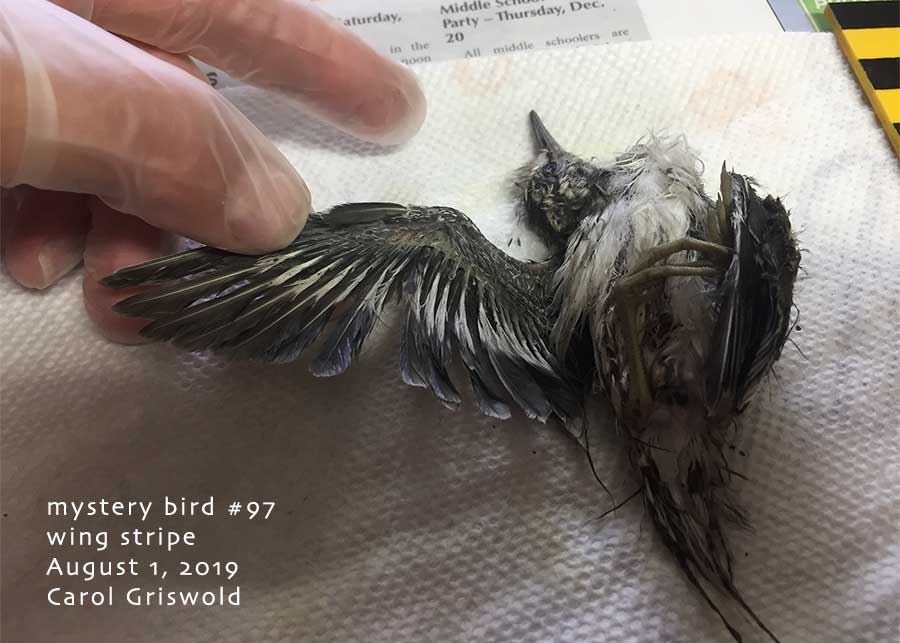
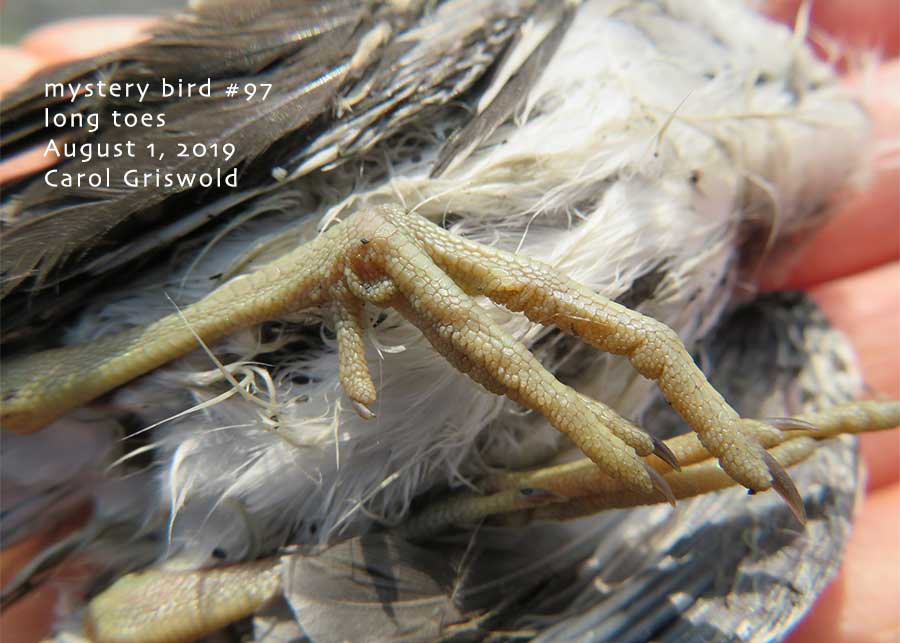
During the August 1, 2019 COASST beach survey, I discovered a small mystery bird floating at the edge of the tide. I have no idea what species it is, but it looks like a juvenile. The eyes were still bright, so it was fairly fresh. 

It has 1 short toe behind and 3 long toes in front which key out to Shorebird, with yellowish legs, eye stripe, straight bill, and inner white wing stripe. What is odd is two, much longer tail feathers trailing out.

The bill is 15.8 mm long, the wing chord is 5.8 cm, and tarsus 25.1 mm.

I appreciate any help with identification.

For more information on COASST, Coastal Observation and Seabird Survey Team, go to https://coasst.org

Thank you and
Happy Birding!
Carol Griswold
Seward Sporadic Bird Report Reporter


September 1 update: 
Many thanks to all who responded so quickly: Aaron Lange, Dave Sonneborn, Carla Corin, Martin Renner, and Jim Stevenson. Juveniles are notoriously difficult regardless of species, including humans (thanks, Jim!). 

Questions arose as to how quickly the bill grows: in proportion to the bird, or like Pinocchio caught in a lie. The two long tail feathers posed another question.

However, the consensus (drum roll please) was juvenile SPOTTED SANDPIPER.

This makes sense as the immediate area is a known nesting site, though I hardly saw any Spotted Sandpipers throughout this summer.

I really appreciate the birding community that is so willing to provide expertise, and this Internet forum that makes it possible. Thank you!


Friday, August 30, 2019 Great Horned Owl!

Seward, Alaska

Around 8 pm, I received a call about a very vocal GREAT HORNED OWL hanging out at the new bike park in Forest Acres.

I rushed over just in time to meet my friends as the first welcome raindrops since June spattered down in the gathering dusk. They kindly guided me to the last place they had seen the owl. 

Yes! On a branch just above a handy yellow marker rope perched the large brown owl. It was staring straight at us, its large yellow eyes illuminated as if by bright lamps. I got off a few photos before it launched and flew off. 

An owl in August! So fun to see!

Happy Birding!
Carol Griswold
Seward Sporadic Bird Report Reporter


Saturday, August 3, 2019 Greater Yellowlegs in person

Seward, Alaska

How timely! Today, I happened upon a pair of GREATER YELLOWLEGS madly feeding in a small intertidal stream by Afognak Beach. Initially, they were poised to flee, but decided “What the heck, the fishing is great!” And so, they stayed but kept an eye on me.

Even without a Lesser Yellowlegs for comparison, they looked huge. Their bills are much longer than the length of their heads, and are thicker, with a thicker and grayer base. The bill point is blunt, not needle-like. The streaking is prominent and darker, and the body contours bulged. Their backs are star-spangled with white spots and dots, and the long legs are brilliant yellow-gold. Very impressive shorebirds! It was so opportune to see them after just pondering about the Lesser ID.

I did not observe swipe-feeding. Splashing and dashing about, they ran after small fish and often plunged up to their eyeballs to catch them and gobble them down. I only caught a glimpse, but some looked like baby flatfish, likely flounders. The water was mostly clear, so visibility was excellent. I however, would starve as the tiny fish zipped away, wriggled down into the scant silt, and quickly disappeared when I walked slowly past.

I left them enjoying the chase and success on a beautiful sunny morning at the beach.

Happy Birding!
Carol Griswold
Seward Sporadic Bird Report Reporter


Friday, August 2, 2019 Yellowlegs ID correction

Seward, Alaska

Thanks to the keen eye of Jim Stevenson, the problematic YELLOWLEGS identification has been resolved! All the photographed birds are LESSER YELLOWLEGS. 

In all his years of birding, Jim has only ever seen Lessers using the swipe-feeding technique. Also, at least in Texas, flocks of Yellowlegs are virtually always Lessers. Greaters usually feed solitarily, or sometimes with a Willet, etc.

Kevin Karlson weighed in with these excellent tips and observations:
Even if the bill is somewhat long, it is a very even, slender shape with a diagnostic needle-like tip only found on the Lesser Yellowlegs. 

Greater Yellowlegs would have a long bill with a thicker bill base and typically a thicker tip as well. Even very young Greater Yellowlegs juveniles show this thicker base, especially females, which have very thick-based bills with fairly blunt tips.

Lesser Yellowlegs have even body contours with gently rounded curves versus the awkward, belly-heavy structure of Greater Yellowlegs. GRYL also show a bulge in the throat when it is retracted, like an Adam’s apple in men, which Lesser Yellowlegs do not have.

I sure appreciate this correction and am pleased to have more clues to identify these tricky species. Thanks so much to Jim and Kevin for taking time to help!

Happy Birding!
Carol Griswold
Seward Sporadic Bird Report Reporter

Thursday, July 25, 2019 Lesser Yellowlegs swipe-feeding

Seward, Alaska

Today I enjoyed watching 14 LESSER YELLOWLEGS feeding in the silty mud at the edge of a small intertidal creek. Singly or in small groups, they slowly waded along on their long, bright yellow legs, necks outstretched, swiping their bills rapidly from side-to-side. As the bills sliced through the water like tiny swords slashing, they gobbled up tiny, muddy, morsels. Big half-bubbles popped up to float decoratively alongside. I have never observed this fascinating method of feeding, and it sure looked effective.

A much larger adult Greater Yellowlegs rushed me from the wetlands, agitated at my presence. Perhaps there were even younger birds hidden nearby, still in need of protection.

A few fledging SEMIPALMATED PLOVERS hunted competently in the tide flats near a dozen parents and other adults. In the creek, eight young GREEN-WINGED TEAL ducklings quickly paddled off as their brave momma ran interference at great potential risk. Two SPOTTED SANDPIPERS called loudly along the shore, bobbing their tails.

The ARCTIC TERNS have largely departed. I only saw one fishing in front of the Scheffler Creek near the boat harbor. Their season has flashed by!

Happy Birding!
Carol Griswold
Seward Sporadic Bird Report Reporter