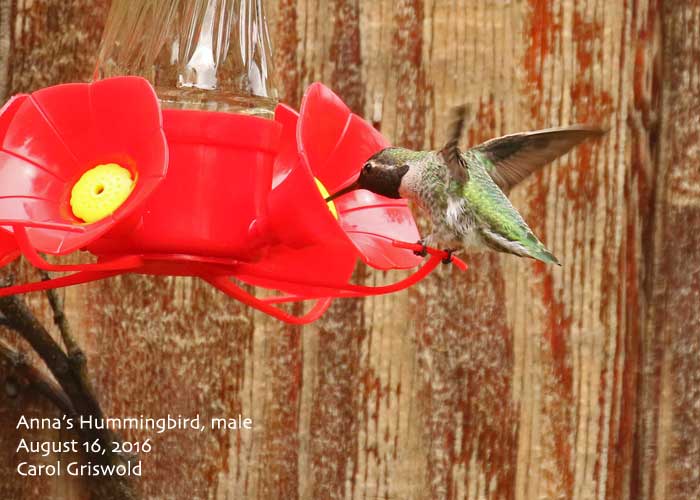
Tuesday, August 16, 2016 Anna’s Hummingbird

Seward, Alaska

The rain stopped and Ava’s Place was hopping today. WILSON’S, YELLOW-RUMPED, and ORANGE-CROWNED WARBLERS flitted through the leaves, gleaning caterpillars and other insects. PINE SISKINS gobbled down thistle seed from the net feeder while youngsters begged. 

A young HAIRY WOODPECKER inspected the wood trim and banged experimentally on the roof while the smaller DOWNY WOODPECKERS checked out the suet feeders. SONG SPARROWS, including youngsters, hopped along the porch and poked through the grass under the porch feeders.

But the star of the show was the male ANNA’S HUMMINGBIRD. He zipped in to the sugar water feeder, rested on the handy perch, and slurped it down, sending up air bubbles. When he turned towards me, his brilliant gorget flashed metallic gold-yellow-orange-magenta-green, an unexpected burst of flames.

Seeing him, I realized that I too, was visited by an Anna’s male that hovered for a millisecond at my kitchen window on August 9th. The encounter was so brief and unusual, I dismissed it when a RUFOUS female showed up at the feeder a short time later.

Ava noted that she has had RUFOUS HUMMINGBIRDS pass through just about every day since the majority of local residents left in mid-July. She attributes this to a range extension beyond Seward. The Anna’s probably represents a range extension as well, as Homer hosted two last winter and two were recently reported there.

Ava requested that visiting birders slow down to a crawl after they turn onto her driveway and approach. All the birds are very flighty and your chances of seeing her birds will be greatly increased.

As the forecasted rain returns, once bright flowers become less inviting, making fresh sugar water in the hummingbird feeders more important to fuel these phenomenal midgets.

Happy Birding!
Carol Griswold
Seward Sporadic Bird Report Reporter


Sunday, August 14, 2016 Herring Gull with transmitter

Seward, Alaska

Today about 1:30, a single Herring-type Gull flew over my head and landed at the tideline. As it passed, I noticed a very odd thing, an antenna sticking out from its back! Its feathers partially covered a gray box, presumably a transmitter. The gull was obviously bothered by this thing and tried to pry and preen it off, without success.

Does anybody know who might be tracking Herring Gulls in Alaska?

It would be interesting to know where this bird started and where it has been. Most Herring Gulls migrate from this area by September, so it may already be en route.

Happy Birding!
Carol Griswold
Seward Sporadic Bird Report Reporter


Friday, August 12, 2016 Trumpeter Swan cygnets learning to fly

Seward, Alaska

Sunrise 6:05 am, sunset 9:57 pm, for a total day length of 15 hours and 51 minutes. Tomorrow will be 5 minutes and 13 seconds shorter. Clouds/rain/fog/mist continues and more is in the forecast for the next week.

Today was a big day for the resident TRUMPETER SWAN family. At first glance, all was calm and uneventful. One parent took a long break near the road in the sedges, mostly napping and occasionally checking the scene. It was unusual for a parent to be so far away. Far across, in the middle of the pond, the seven cygnets stood on the old nest site preening and stretching. The other parent was out of sight, possibly napping as well.

One after another, each cygnet briefly stretched its wings during the extensive preening process. Their wings were surprisingly large and a startling white against their light gray-brown bodies. Then the adult paddled out from behind nest site and floated in the nearby open water, as if to say, “Come to momma!” (Or poppa.)

I wonder if these cygnets have ever seen their parents fly. Mostly, there was no need as all they ever needed, from nest to food and water, was right here and accessible by paddling. Would they know what to do with those giant wings?

In a jumble, they hopped over the edge, wings outstretched, and beat their way across the water, huge feet pattering on the surface, but never quite getting airborne. What excitement! ALMOST flying! It was like watching baby’s first steps, swan style.

The triumphant cygnets gathered around their proud parent and resumed preening. But Number Seven was still on the nest site, stretching and flapping its mighty wings back and forth, back and forth, testing their strength, as it propelled itself in tight circles. Then it came to the nest edge, and flapped some more, back and forth, back and forth, wanting to go, but not sure. Suddenly, as if worked into a frenzy, off it went, wings flapping mightily as it raced along the surface, leaving giant splashy footprints. "Look at me!"

Every swan stopped preening as it came to a gliding stop just in front of the family, and watched the newest aviator land. Even the parent taking a break had its long white neck up like a periscope to see. It was quite a milestone for the cygnets. It won’t be long before they are accomplished flyers, and then it may be harder to find them.

I felt like a doting auntie, so pleased to watch these young, strong cygnets grow up, and so proud. We are so lucky to be able to observe these special birds and special moments right here in Seward.

Happy Birding!
Carol Griswold

Seward Sporadic Bird Report Reporter


August 10, 2016 Red-necked Phalaropes in Seward

Seward, Alaska

Just a few days ago, RED-NECKED PHALAROPES were reported in Kenai Fjords National Park. Tasha spotted four near the breakwater by the Alaska Sealife Center this afternoon. Thanks to her hot tip, I was able to refind three, including a juvenile.

The birds were riding the incoming waves and the sloshing rebound off the shore. I saw one dive underneath a particularly large wave, then bob right back up. They were in constant motion, like a wind-up toy, feeding in the ribbons of detritus, quickly picking out zooplankton, tiny crustaceans, and mollusks.

The adults were molting into winter plumage, but retained a bit of reddish color on the neck. The juvenile wore a dark crown that covered her entire head, and was otherwise brown, black, white, and gray. She was larger than the nearby male.

The smallest of the three species of Phalaropes, only 6 to 8” long with a 14-15” wingspan, this shorebird spends most of its life on the open ocean. It breeds in tundra ponds in Alaska and northern Canada, then migrates down the Pacific coast to overwinter on the ocean off the coast of South America.

The female is larger, has brighter plumage, and after laying her four eggs, leaves to let the male incubate and care for the young. There must be some evolutionary advantage to this, as so many males of other species seem to benefit from this strategy. Instead of considered “normal” this is called a “switch of traditional roles”. Party on, little lady!

Info gleaned from the Wildlife Journal Junior http://www.nhptv.org/wild/redneckedphalarope.asp

Also of note, this afternoon I received a report of a juvenile SAW-WHET OWL being mobbed by fearless NUTHATCHES and CHICKADEES. I arrived late and missed it. Perhaps that diminutive little guy was in my spruce yesterday, causing a similar disturbance in the Universe as we know it.

Happy Birding!
Carol Griswold
Seward Sporadic Bird Report Reporter