Tuesday, March 15, 2022 Mountain Goats!

Seward, Alaska

Seward's snowy mountain slopes may look spectacular, but the deep snow and crusty surface has forced hungry mountain goats to descend to the forest to find food.

Thus, I was watching for mountain goats on the cliffs and steep slopes of Bear Mountain, while dodging potholes and rocks as I slowly drove along Lowell Point Road. Suddenly, I spotted three goats in a snow patch at the top of a large slide zone, much creamier in color than the white snow. Then three more in the hemlock-spruce forest above, grazing in the mossy green vegetation and browsing on tree needles and still-dormant twigs. Wow! Six goats! I immediately pulled over and started clicking away.

Another goat emerged from the north (right) edge of the slide, pausing to nibble on alder twigs before ambling across the treacherous, steep slope. She paused on a dirt outcrop, posing like a Mt Marathon racer at the glory rock, and regarded me calmly. Her shaggy fur coat looked freshly brushed and cleaned, even her fashionable beard and the stockings below her knickers were clean. Such a pretty nanny!

As she carefully negotiated the remainder of the slide crossing, little rocks pattering down, another pretty nanny appeared from the north side. She too, approached the glory rock and posed! Before she left, she turned to look back and waited. More were coming

The next nanny had a distinctive left horn with a bent and enlarged tip. She followed the other nanny, but then stopped to look back. Another nanny was coming, browsing on the alder twigs. It looked like she was smiling.

After she crossed, here came a darling yearling, her wide-spaced, tiny horns barely erupted. Her feet and belly were brown with mud. After consideration, she crossed from snow patch to dirt slope, following the others. At the edge of the crossing, she joined the last nanny, likely her mom, and they strolled off together. Was that all?

No! Next came two-year old kid with horns almost as long as her ears. When she successfully reached the end, she looked back. Now who?

Another adorable two-year old. Her twin? She too, posed mid-way and looked back. This herd really kept track of each other! Here came a nanny, perhaps her mom. Then another nanny followed closely by an adorable yearling with tiny horns. The baby bravely and deliberately crossed the unstable steep slope, rocks skittering underfoot.

As the one left the slope, another entered as if on cue, this time another two-year old with horns about as long as its ears. Then another kid, its twin? I was losing track! As the last one reached and posed at the glory rock, she too looked behind. Here came another nanny, perhaps the mom.

That group soon disappeared as another nanny emerged. This one seemed to be molting with a decidedly shorter patch on the hind leg. She posed on the glory rock and looked behind, but I didn't see anyone else coming. Maybe she was the caboose, and, as a good leader, just making sure everyone had crossed.

What a magical encounter! I estimate a minimum of 13 adults, two yearlings, and four two-year old kids for a total of 19 mountain goats that ambled across that slide in a steady stream over a span of 15 minutes. 

I understand the billy goats are not welcome to join the nannies and babies in the winter when food is very scarce (enforced by the moms' sharp horns). The billies fend for themselves, ranging far and wide, leaving the more accessible food for the vulnerable family group. 

What I find even more amazing about these incredible and hardy year-round residents, is that the pregnant nannies are basically eating a starvation diet of twigs, hemlock needles, dead grasses and sedges, seaweed, and whatever else might provide calories to feed themselves and their growing babies. With such shaggy coats, I could not tell if any were pregnant, but one can hope!

Around Mother's Day, in the second week of May, they will give birth to singles, or sometimes twins, and the cycle of life begins anew. 

Happy Birding! (while watching for mountain goats)

Carol Griswold

Seward Sporadic Bird Report Reporter


Sunday, March 6, 2022 Beautiful day and boat harbor birds

Seward, Alaska


Sunrise 7:42 am, sunset 6:38 pm for a total day length of 10 hours and 55 minutes. Tomorrow will be 5 minutes and 29 seconds longer.


Ahhh, sunshine! So welcome after the many days of successive storms and sn'rain. After an overnight low of 25, the high today reached a balmy 41 that actually felt warm. As per usual, the north wind couldn't resist demanding some attention too, and ripped around at 12-18 mph with gusts to 26.


Nature whipped off her secretive grey shroud to reveal her masterpieces: brilliant white snowscapes on the surrounding spectacular mountains. Snow devils and streamers danced off the summits for a final artistic touch. 


I wandered around the boat harbor floats, where the warm sun neutralized the wind. Sheltered between the rows of vessels, the water was remarkably calm. Singly and in small flocks, sea birds quietly dove for fish. 


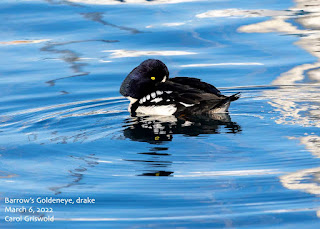
HORNED GREBES, red-orange eyes aglow, popped up and watched warily before diving under the floats to reappear many yards away. A flotilla of BARROW'S GOLDENEYES wove in and around boat hulls as if on inspection. Among them, young males, still brown like females, sported developing white face crescents. A few COMMON MERGANSERS, normally present in large numbers, paddled about.


I heard a distinctive "BEEP" and crept up on displaying COMMON GOLDENEYE drakes. How fun to watch these handsome sea ducks at work, trying to impress each other and the ladies! 


I know I was impressed when one after the other drake threw his head flat on his back, beak to the sky, and uttered a dry rattle. Then back up for the "Beep!" and the neck extended fully at an angle (probably felt good to balance out that neck throw). The boys followed each other around, showing off, ladies or not, then preened to perfection.


The mountain shadows crept over town and finally reached the harbor around 4:46 pm. As the sun slid over the side of Mount Marathon, the slope edge ignited in a dramatic farewell, loose snow billowing over the scattered, iced alders. 


I caught the reflection of Mt Alice, still alight across the bay, in the large windows of a tour boat office at the edge of the harbor. Summer visitors miss our mountains' blue snow shadows, low angle light, long, sometimes starry nights, and the harbor with overwintering, beeping sea ducks. What a sweet pleasure!


Happy Birding!

Carol Griswold

Seward Sporadic Bird Report Reporter


Saturday, February 5, 2022 A fun but monochrome day to bird

Seward, Alaska

Sunrise 9:03 am, sunset 5:22 pm for a total day length of 8 hours and 19 minutes. Tomorrow will be 5 minutes and 9 seconds longer.


Monochrome day today; the flat pewter sky merged with the calm silver bay. Temperatures continued mild with a low of 29 to a high of 38; the bay hovers around 43º. A brisk south wind lost interest early and gave up entirely but the north wind picked up in the evening. Snow and snow showers forecast for next week.


On Wednesday, Robin C reported 2 male and one female Green-winged Teal at Clear Creek and an AMERICAN TREE SPARROW at Ava’s off Salmon Creek Road. He has consistently located the TOWNSEND’S SOLITAIRE in town, generally along Second Avenue and often near the historic Episcopalian Church at Second and Adams. 


Also on Wednesday, David J reported three species of Loon at the harbor entrance: 2 COMMON, 1 YELLOW-BILLED, and a very unusual (for Seward) RED-THROATED LOON.


I searched the Uplands and harbor since then but only refound the juvenile Common Loon, several red-eyed HORNED GREBES, sleek PELAGIC CORMORANTS, GOLDENEYES, and even a pair of GREATER SCAUP, all busy fishing. 


In addition, today, two male BARROW’S and COMMON GOLDENEYES worked along the breakwater rocks, nibbling on mussels and other treats exposed at low tide. A BELTED KINGFISHER flashed past; a SONG SPARROW called from the rocks.


While at the harbor, I enjoyed a serene HARBOR SEAL lounging at the surface like an inflatable toy, its nostril flared wide open to breathe, and then slit shut to dive. Such big, liquid brown eyes and long whiskers (vibrissae)! Silently, a second seal surfaced, then both submerged simultaneously. Sssss.


I spotted a Sea Otter stretched out, sleeping on the swim platform at the stern of a boat, snoring away, not a care in the world. More industrious were two River Otters, resting on the rocks, feasting on fresh fish. One Otter struggled to subdue its uncooperative fish and finally chomped it into smaller chunks. 


I headed to the tidelands to search for the Snow Buntings and two McKay’s Buntings reported earlier this week. Instead I found 50 ROCK SANDPIPERS chittering gaily and snarfing up invisible (to me) invertebrates and clams. Flashes of yellow legs and yellow-orange bill bases brightened the monochrome palette. One drab-brown DUNLIN with a long droopy bill mingled with them, enjoying their company and protection.


A male BELTED KINGFISHER waited patiently for dinner by a creek.


Tasha reported a pair of GREEN-WINGED TEAL at the tidelands and a NORTHERN SHRIKE. The bird scene is dynamic!


Late in the afternoon over at Afognak Beach, Tasha discovered a large flock of 80+ SNOW BUNTINGS and at least two MCKAY’S BUNTINGS in the beach rye grass at the high tide line. This is the highest number of Buntings this year, and so exciting to have McKay's here.


Once again, the birds and other wildlife brightened an otherwise dim winter day.


Happy Birding!

Carol Griswold

Seward Sporadic Bird Report Reporter


Monday, January 31, 2022 Common Redpolls

Seward, Alaska

Sunny, 15-27º, north wind.

Just by chance, I happened to be standing quietly near a nice cluster of catkin-laden alders at Lowell Point State Recreation Site. Not a bird was heard, none in sight. I waited. Then suddenly, a flock of about 20 COMMON REDPOLLS swarmed to an alder farther away and began extracting the tiny seeds from the woody, cone-like catkins. I waited.


Sure enough, bit by bit, they moved closer and closer. Finally, the small finches were right by me, giving me wonderful views of their red caps and raspberry-pink fronts. A rump view looked like Nature took a small brush and carefully added rosy marks to the light brown canvas above the tail.


The Redpolls bounced like bumblebees from one catkin to the next, making quick work of the snacks. Grasping the catkins with strong, black toes, they nonchalantly hung upside down, sideways, and perched on top. Their yellow bills deftly extracted the tiny nutlets, peeled away the papery wings, and gobbled them down.


Upon an invisible signal, they all surged to the next alder, fleeced its calories, and then swirled away, leaving me with the quiet once again. I waited. Hearing and seeing none, I reluctantly left the park and the sun, knowing a week of mixed rain/snow/sleet was forecast. 


Happy Birding!

Carol Griswold

Seward Sporadic Bird Report Reporter