Tuesday, February 9, 2021 Orcas in bay!

Seward, Alaska

Sunrise 8:53 am, sunset 5:34 pm, for a total day length of 8 hours and 41 minutes. Tomorrow will be 5 minutes and 16 seconds longer.


After a sunny but chilly Sunday with temps in the low teens, snow-laden clouds rolled in but few snowflakes sifted down. Actual snowfall measured in inches is forecast for the next several days as temps rise to a high of 30.


The news spread fast and small crowds gathered along the Waterfront around noon: three ORCAS in the bay! The trio swam from the freight dock almost to Lowell Point then returned. One had a smooth, strong dorsal fin, another’s was nicked and gouged. Sadly, the normally tall dorsal fin of the male, which can grow up to six feet high, was flopped over to the left side, completely collapsed, a sign of an injury, age, stress, dehydration, toxin accumulation, or general poor health. 


A local whale researcher noted these are definitely transients, frequently seen in the Gulf of Alaska (GOA) area. They are likely hunting for Steller sea lions (often seen lounging by the Uplands/Sheffler Creek area) and harbor seals (also there and scattered around the bay).


The North Gulf Oceanic Society webpage notes: http://www.whalesalaska.org/killer-whales-southern-alaska.htm

GOA (Gulf of Alaska) transients

“The transients in this population, unlike the Chugach transients, are seen infrequently and sporadically in Prince William Sound and more often in Kenai Fjords, usually in the ocean entrances or along the outer coast. Eight of these transients have been genetically sampled. 


“All differ in mitochondrial DNA from both the Chugach transients and the West Coast transients of British Columbia and southeastern Alaska. 


“It is not uncommon for many years to pass between sightings of individuals within this group, although some matrilines are seen more frequently. The detailed habits and range of these whales are unknown, but the infrequent resightings suggest a large, perhaps offshore range. Their population is not large but seems stable from our recent analysis (Matkin et al 2012). 


“From photographs contributed by other mariners and biologists we have tracked many of these whales to the Kodiak archipelago, but none have matched photos of transients from the Aleutian Islands and Bering Sea. 


“This supports genetic work that indicates transients in western Alaska are a separate population(s). Tagging data indicates they venture well offshore, at least to the shelf break. Gulf of Alaska transient whales may remain in an area for days or weeks, especially in regions where there are harbor seal or Steller sea lion haulouts. Then they may move on and not be seen again in that area for extended periods; sometimes for years. 


“Matushka (AT109), her probable daughter AT111 and the daughter’s offspring AT125 and AT 159, are seen in Hinchinbrook Entrance, Prince William Sound and at the Steller sea lion rookery at the Chiswell Islands, Kenai Fjords. 


“In general, the Gulf of Alaska transient killer whales seem to have more nicks or gouges in their dorsal fins than resident killer whales or the Chugach transients. These wounds may result from encounters with Steller sea lions, which are larger and more aggressive than harbor seals or Dalls porpoises.”


I overhead some observers calling them, “Kodiak Killers” a transient group that includes a male, Sasha, AT127 whose fin flopped over in 2005.


Check out this article on another male with a flopped over fin on the left in BC Canada: https://wildwhales.org/2014/07/07/the-case-of-the-flopped-over-fin/


While watching for the whales from Lowell Point Road, I heard a sudden rustling behind me and turned in time to watch an adult BALD EAGLE launch from a nearby spruce tree. It flew purposefully out into the bay over the head of a startled PELAGIC CORMORANT and nabbed something from the water. Then it flew back to its perch. It was difficult to see what it had; just hope it was a fish and not a Marbled Murrelet.


I continued out to Lowell Point Beach to see if the Orcas went around the point. No, but a MEW GULL foraged at the edge of the ebbing tide. A larger immature THAYER’S GULL swooped in, almost on top of it, and took over that particular small stretch of beach. Other than the Gulls, I only saw a few PELAGIC CORMORANTS from the beach.


On Sunday, I watched a HORNED GREBE wrestling with something that looked like a glob of seaweed A closer look revealed a Sculpin with all its spiny fins extended, trying to make itself too large to swallow, fighting for its life. The Horned Grebe persevered and finally got the subdued fish arranged head forward, tail back. I was amazed to see it go down the small Grebe’s throat. It must have felt a bit prickly heading to the stomach!


As for the BRAMBLING, he has been seen in the same neighborhood and often the same yard as before in the alley south of Marathon Drive, sometimes with the 5 or 6 RUSTY BLACKBIRDS and the single female RED-WINGED BLACKBIRD.


The SIBERIAN ACCENTOR has proven more elusive; no reports for about a week. I hope he’s still around.


Happy Birding (and whale watching!)

Carol Griswold

Seward Sporadic Bird Report Reporter


Monday, February 1, 2021 Glaucous Gull

Seward, Alaska

Sunrise 9:12 am, sunset 5:12 pm for a total day length of 8 hours, zero minutes. Tomorrow will be 5 minutes and 2 seconds longer.


While neighbors to the north experienced below zero temperatures, Seward remained relatively balmy with an overnight low of 5 and daytime high of 21. The raging north wind, at 20 to 30 mph, whisked away any actual heat from the bright sunshine, leaving only the psychological boost.


Our sunny interlude is forecast to be interrupted tomorrow with a chance of snow by evening, then alternate between snow showers and sunshine.


Even the sea birds sought refuge from the wind. A toasty raft of COMMON MERGANSERS preened and bobbed in the lee of the Uplands breakwater. GLAUCOUS-WINGED GULLS and a few MEW GULLS joined them on the rocks. 


In the blast by the Mariner’s Memorial, hungry NW CROWS (aka AMERICAN CROWS) braved the elements for handouts. A smattering of Gulls joined them, then sat down facing north, hunkered down on the ice and frozen snow. Among them was a first cycle GLAUCOUS GULL, first spotted nearby yesterday by Sulli and Dave S. 


Sulli and Dave also refound the BRAMBLING at the usual location in the Marathon Drive alley, and the female RED-WINGED BLACKBIRD with the five RUSTY BLACKBIRDS.


The SIBERIAN ACCENTOR continues at Second and Madison, but requires patience and luck. The female ROBIN that dined on freeze-dried Mt Ash berries among the decorative greens in the window box and on the door wreath, was apparently nailed by a hungrier SHARP-SHINNED HAWK moments after Sulli and Dave saw it. Sure wish Pigeon was on the menu instead.


Swirling in the wind, small flocks of WHITE-WINGED CROSSBILLS managed to land in the tops of the swaying spruce trees to dine on the cone seeds.


Happy Birding!

Carol Griswold

Seward Sporadic Bird Report Reporter


Saturday, January 23, 2021 Feeder birds

Seward, Alaska

Completely calm yesterday; the spectacular reflections of the snowy mountains doubled my joy.


I watched a female HAIRY WOODPECKER probe for suet in Ava’s suet logs, expertly balance on the suspended stuffed pine cone, rap experimentally on the battered porch post, and then explore the hidden contents of the dollhouse feeder. Hungry bird! 


A male DOWNY WOODPECKER also found food in the dollhouse, much to the annoyance of the entitled BLACK-CAPPED and CHESTNUT BACKED CHICKADEES and RED-BREASTED NUTHATCHES who had to wait their turn.


A few PINE GROSBEAKS, including a brilliant red male, feasted on the sunflower seeds in the porch railing feeders.


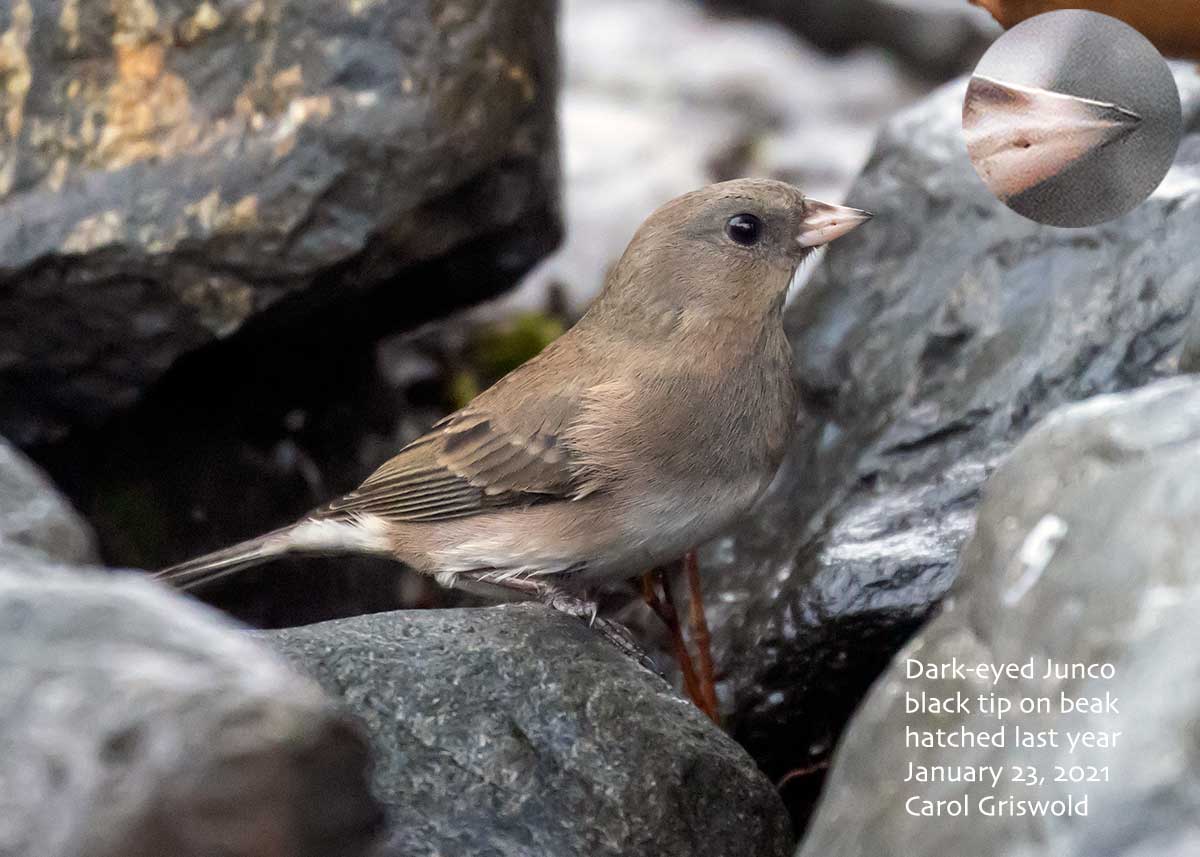
Thanks to a tip from Tasha, I recognized a DARK-EYED JUNCO as a young bird, hatched last summer. These youngsters have a tiny black spot on the tip of the bill which is not seen in adults. The juvenile birds’ feathers are worn and their primaries are thin as this plumage is still their first real feathers.


Always more to learn!


Happy Birding!

Carol Griswold

Seward Sporadic Bird Report Reporter


Tuesday, January 19, 2021 Siberian Accentor and friends

Seward, Alaska

A delightful sunny day with temps in the 30s today, a welcome reprieve after yesterday’s steady rain.


I stopped by the Madison and Second hotspot to check for the Siberian Accentor. The afternoon sailed along with the whims and needs of the visiting birds. A small flock of Pigeons descended warily and were as quickly shooed away only to return a short while later to grab a few pecks of bird seed, and again be shooed.


A female ROBIN watched from the nearby spruce trees, then bravely flew down to the wreath on the front door to snatch a few decorative freeze-dried Mt Ash berries. Clever Robin to find this stash of now-scarce berries.  


A single BOHEMIAN WAXWING lingered momentarily then flew on, probably also looking for scarce berries.


Around 2:00 pm, DARK-EYED JUNCOS dropped down from their hiding places in the surrounding vegetation to gather seeds from the icy snow. At 2:05 pm, the SIBERIAN ACCENTOR appeared just for a few minutes to feed, then vanished. He reappeared at 2:56 pm, and again at 4:27 pm.


Near dusk, a SHARP-SHINNED HAWK flashed through after a fleeing WHITE-CROWNED SPARROW and disappeared, leaving the conclusion unresolved. 


Alongside the bird activity, vehicles occasionally drove past on Second and pedestrians strolled up and down, often briefly flushing the birds. Then came a RAVEN striding up the street just like a very short person, with a huge prize in its beak. It kept walking, even across the intersection and past, pleased and confident. Ravens do what they do, and it’s always interesting to see!


Happy Birding!

Carol Griswold

Seward Sporadic Bird Report Reporter


Saturday, January 16, 2021 Siberian Accentor sighting

Seward, Alaska

Good news! I saw the SIBERIAN ACCENTOR today, feeding in a horde of PINE SISKINS at the usual hotspot on Madison and Second.


It didn’t linger long, but it’s nice to know that it’s still here.


Happy Birding!

Carol Griswold

Seward Sporadic Bird Report Reporter

Friday, January 15, 2021 Northern Pintail, Pacific Loon, Eagle action, and a bit of blue sky

Seward, Alaska

Sunrise 9:46 am, sunset 4:30 pm, for a total day length of 6 hours and 43 minutes. Tomorrow will be 3 minutes and 54 seconds longer.


Finally! The relentless precipitation in its many variations ranging from fog, rain, drizzle, sn’rain, sleet, and snow held off until a touch-up light freezing rain in the evening. The landscape is white, but it’s a deceptive, heavy, sloppy two-plus feet of snow. The sun peeked out this afternoon, illuminating the stunning mountains on the east side of Resurrection Bay, reminding me of why I love to live here.


More precipitation in the forecast for the next week with temps reaching 38 for the next few days. Maybe we’ll see some sun by next weekend.


First reported by Robin C, a handsome drake NORTHERN PINTAIL showed up, unbelievably early on January 10. I refound him on January 12 standing on ice at the airport pond among dozens of MALLARDS, calmly preening in a light snow. He'll have to wait several months for his true love to migrate north!


The SIBERIAN ACCENTOR at Madison and Second continues to be seen by some, but has proven elusive for me. As I searched yet again in vain, I was reminded of the song wherein an Eagle hauls off a Dove, and the Accentor can’t be found: “Love the One You’re With” by Crosby, Stills & Nash. 


Yes, it’s astonishing how PINE SISKINS can crack open a hard sunflower seed hull and extract the meat with only a tiny, thin bill, manipulating the seed with their tongue while standing on snow. I observed a lot of this action while waiting. 


I haven’t seen the Brambling in a while either, but the 5 RUSTY BLACKBIRDS and single female RED-WINGED BLACKBIRD preened and chatted high in a cottonwood during a brief sunny break on January 13, still in the alley behind Marathon Drive. Update: BRAMBLING reported today in same location.


On January 3, I saw an odd-looking Loon in the gloom just outside the boat harbor entrance. It had a large white patch on its right side that was not snow. 


Today, I got a better look from Lowell Point Road. The left side was normal, and turned the bird into a PACIFIC LOON with a wing injury. Tasha refound it and said the injured wing is not resting in the correct position so the white side is now visible. She was concerned about the amount of time the Loon was preening, likely due to the injury, as that is time away from feeding and also a signal to predators like Eagles. She thought the body condition looked good, which is hopeful.


It was so peaceful watching and listening to the many MARBLED MURRELETS whistling to each other as they paddled on the calm bay backdropped by the scenic snow-clad mountains. Tasha estimated about 40. 


As I finally drove off, I saw a BALD EAGLE suddenly swoop down over a pair. I hope they both dove in time, but the Eagle seemed to have something in its talons as it flew off. Though I pulled over to watch the Eagle after it landed on the road snow berm ahead, I never saw it eat, so maybe the Murrelet escaped. 


The high tide attracted small rafts of BARROW’S GOLDENEYES to steam directly towards the road, then dive in synchrony up close. In reverse synchrony, they popped up facing the bay and paddled off a short way. Then the group turned 180 and headed back to repeat the show. In and out like a feathered tide. Such beautiful seabirds; I love their golden eyes and the males’ dramatic black and white pattern. The Eagle, now suspiciously perched above in a spruce tree, was also watching, but I didn’t see any attempts to nab one.


After I tore myself away, I almost immediately pulled over again to take photos of unusual wavy clouds. They may be Kelvin-Helmholtz Clouds aka billow clouds, formed when two horizontal winds meet. The higher velocity wind on the top picks up a layer of clouds and forms wave-like rolls. https://www.thoughtco.com/kelvin-helmholtz-clouds-3443792


All in all, a very interesting and uplifting day!


Happy Birding!

Carol Griswold

Seward Sporadic Bird Report Reporter