Tuesday, October 28, 2014 Ghoulish Activity!

Seward, Alaska

How would you like to find a large headless bird plopped in your driveway in a pool of fresh, red blood with scattered blood splatters leading to it? This was not a Halloween trick and my friend was mystified.

We inspected the evidence, a large plump body with short wings and strong feet reminiscent of a chicken’s, with feathers. The black and white breast feathers looked like an artist painstakingly painted each one; the dark tail was tipped with a complementary chestnut brown. This was a bird of the dim and shadowy forest, perfectly camouflaged for sitting on a spruce branch. All in all, a remarkably lovely bird despite the gruesome circumstances and pencil-sized hole under one wing.

Even without the head, I recognized the species and gender. Do you? Answer revealed at the end!

Noting that this forest bird was not a strong flier nor a migratory species, one way it ended up splat on her driveway could be that a raptor of some sort grabbed it in the nearby forested mountain slopes, its sharp talons piercing the body. After ripping off the head (ew!) the predator must have been disturbed, perhaps by another hungry bird, and flew off with the prize. Perhaps there was an aerial altercation and the hapless, headless bird was dropped just before the two antagonists hit her house.

Before they could compose themselves and grab the tasty meal, here comes the homeowner in her car, about to receive a shocking surprise.

While I know the prey, I don’t know the predator. I wonder if perhaps a NORTHERN GOSHAWK is in the ‘hood. They would be more likely to hunt down this forest bird than the often seen BALD EAGLES. I have not seen any goshawks, but am now on the alert, as it is very possible.

So, the answer to the riddle: it is a male SPRUCE GROUSE.

Happy Birding!
Carol Griswold

Seward Sporadic Bird Report Reporter


Sunday October 12, 2014 Seward swan family visits the Seward Boat Harbor

Seward, Alaska

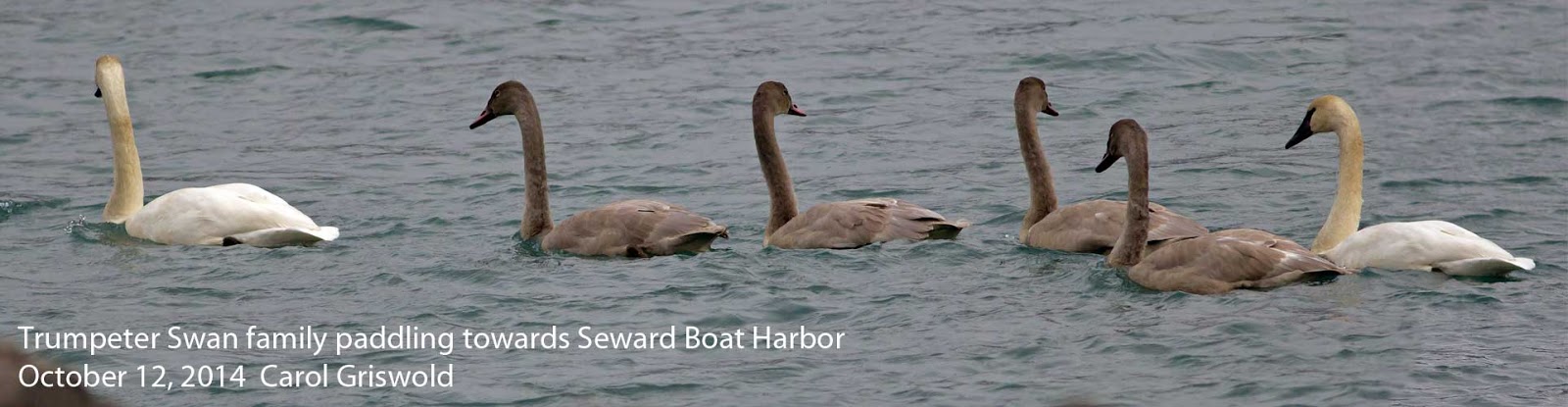
A chilly, dark, fall afternoon; sn’rain spit intermittently at sea level while snow accumulated on the mountainsides. A good day to bird from the car. I parked by the Mariners’ Memorial on the harbor uplands to look for seabirds. Immediately, my attention switched from dot birds to a majestic flotilla of six TRUMPETER SWANS, two adults and four cygnets, paddling directly below me along the rocky breakwater, honking softly. They looked apprehensive and uncomfortable in this unusual habitat, as well they should.

I snapped a few photos from my car blind. The leader lowered his/her head to take a sip of saltwater, and unsurprised, raised its long neck to swallow it down. No one followed suit or stopped paddling. I watched them slowly disappear around the corner into the entrance of the Seward Boat Harbor. Hmmm, sez I, I wonder if I could sneak over to the fish cleaning station on the nearby float and catch them steaming into the boat harbor? So I did! We had about the same distance to cover, but I walked faster than they paddled.

Shortly after hiding myself behind the cover of the fish cleaning station, sure enough, here comes the leader with all four cygnets paddling in a line behind him/her with the other adult guarding the rear. The lead adult nervously stretched its magnificent, powerful wings, then resumed the impromptu tour.

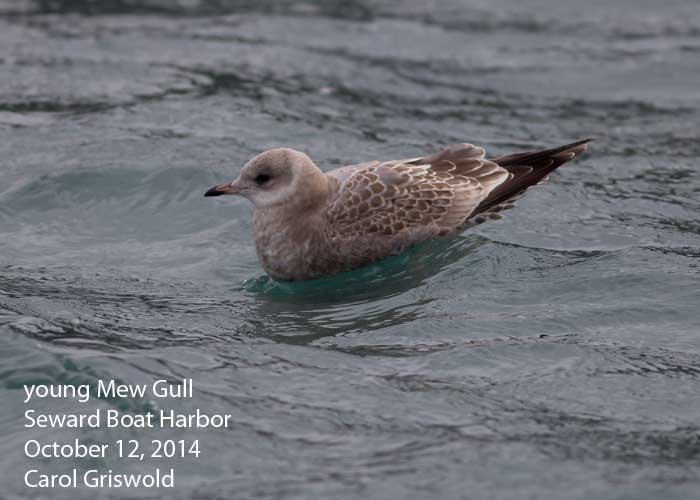
Despite the lousy weather, of all things, a boat decided to head out. The swans moved to the other side as the delighted skipper took a few photos on his way out. One does not often have to navigate around swans here! Another boat snorted to life and the swans milled about, not very happy about this alien scene. A few BLACK-LEGGED KITTIWAKES, MEW GULLS, and GLAUCOUS-WINGED GULLS circled hopefully over the fish cleaning station, a harbor seal popped its shiny head up to look at the new visitors; a sea otter nonchalantly cruised backwards, oblivious, crunching noisily on a mussel.

Hey kids! What doesn’t belong in this habitat? The swans took the hint and were soon beating their giant wings and running along the water next to the US Coast Guard Cutter Mustang, gaining momentum and lift-off. They soared over the tall harbor lights, over the coal loading conveyor, and aimed for the familiar wetlands at the head of the bay. THIS Sunday afternoon expedition was over, and the lesson learned.

I stayed a bit longer to enjoy the sight and sounds of the sea otter, enthusiastically smacking on yet another mussel as a SONG SPARROW sang from the breakwater, and NORTHWESTERN CROWS cawed nearby. I wonder what they thought of those big, white, long-necked visitors from another world in their boat harbor?

Happy Birding!
Carol Griswold
Seward Sporadic Bird Report Reporter


October 5, 2014 Tern Lake Trumpeter Swan Cygnets, Spawning Red Salmon, and Dippers

Tern Lake, 38 miles north of Seward, Alaska

On my way home, I took a break at Tern Lake. The weather had not improved, indeed it was trying harder to snow/sleet and that north wind was chilling. I forgot all about it as I approached the little boardwalk at the Tern Lake picnic area on the west side of the lake. Hundreds of Sockeye or Red Salmon, now maroon and green, packed against the banks of Dave's Creek, almost motionless in the still water. Others swished and swirled in the current closer to the bridge, actively spawning. If I remained quite still, several pairs ventured closer, almost under the boardwalk. When I moved, they darted away. What a sight!

I heard the cheery announcement of a DIPPER as one zipped past and landed on a rock near the bridge. What a busy little gray bird! It bobbed and darted, stuck its head under the cold rushing water, popped back, picked and poked along the slippery rocks, flipped a yellow cottonwood leaf off its rock into the current, and chattered and clattered. Though the yellow bill was fading, it marked this one as a youngster.

Much to my delight, two more Dippers buzzed in and the trio took over the bridge, first perching on the railing then peering at the stream from the walkway just like tiny tourists. Then they all dashed to the stream, briefly investigated the rocks and flashed away downstream. As Dippers tend to be solitary, I suspect this was a family group out enjoying another fine day, singing to the stream and the sleet, happy to be in this fabulous home.

Back on Highway 9, I immediately pulled over to watch 5 adult TRUMPETER SWANS and 7 CYGNETS. What a collection of grey feathers, long necks, and pink bills packed together! It was such a treat to see so many cygnets; there weren't any at Potter's Marsh, and few along the highway ponds. They fed on the underwater vegetation industriously, stretching deep underwater, and surfacing only to get another breath before submerging again. Two adults guarded these precious cygnets; could it be they raised all seven? Regardless, this flock seemed content to be together, ready to care for each other on their long journey south, far from the impending snow and ice. Bon voyage!

Happy Birding!
Carol Griswold
Seward Sporadic Bird Report Reporter


Sunday, October 5, 2014 Tundra and Trumpeter Swan on the move

Potter's Marsh south of Anchorage, Alaska

Sunday, October 5, 2014 Tundra and Trumpeter Swans on the Move
Potter's Marsh south of Anchorage, Alaska

Mid-afternoon and 120 miles from Seward, I stopped briefly at a Potter's Marsh pullout to enjoy watching a small group of swans. A single TUNDRA SWAN, smaller, and with a yellow patch on its bill, lingered near the scattered pairs of TRUMPETERS that were busy preening and paddling to and fro. Spitting snow and a cold north wind lent a sense of urgency to the scene. Accompanied by murmurs and gentle honking, the swans bobbed their graceful heads up and down, sometimes alternately, sometimes in synchrony. Decisions were being made.

Abruptly, one Trumpeter bobbed deeply and then dramatically reared back, wings raised wide and ready for action. The targeted swan stretched its giant wings in response but quickly turned to half-run, half-fly just out of reach of the threatening open beak and arched neck of the angry swan. The sudden attack ended after a short chase, no physical harm inflicted, just wounded pride. The Tundra swan watched it all from a safe distance behind them. All is not peace and harmony with these angelic-looking swans!

Further consultations by the aggrieved Trumpeter swan pair, evidenced by the increasing tempo of head bobbing, (so fascinating to watch!) resulted in a decision to fly off to another section of the marsh. The smaller Tundra swan flew off with them, apparently accepted as an amicable migratory companion.

The spectacular swan show resolved, I got back to the welcome warmth of my car and migrated down the road, south, to my home.

Happy Birding!
Carol Griswold
Seward Sporadic Bird Report Reporter
on the road


Monday, October 7, 2014 From the Ocean to the Ice and Out into Space


Seward, Alaska

Seward is an astonishing, spectacular place. While watching the STELLER'S EIDER dive and preen at Fourth of July beach, I also took notice of the golden cottonwood leaves framing Godwin Glacier. Jellies, symmetrical, graceful aliens from the ocean universe, pulsed gently just feet from the beach, their last gasp at the end of their brief life cycle. Others glistened along the shore, gelatin masterpieces.

A short drive up Resurrection River valley led to Exit Glacier in Kenai Fjords National Park. The crisp air smelled like fall, all of summer's memories captured in the faded cottonwood leaves rustling across the trail.

Fourteen snow-white mountain goats dotted the steep mountainside; two rested regally at the very top, with a royalty's view of their kingdom. Exit Glacier lay half in shadow, half in sun, a suiting description of the season.

Shortly after sunset, a stunning moon popped over the mountains framing Resurrection Bay. A GREAT BLUE HERON squawked overhead, circling; an adult BALD EAGLE veered away from its last minute, futile attempt at dinner.

And over at the Seward Founder's Monument, the weathervane train tipped to the north, north to the future; the lights of the Seward shipyard glowed along the shore.

From the ocean, to the beaches, the wetlands, coastal rainforest, to the mountains and ice, and out to space, may Seward cherish her beauty, birds, wild life and habitat while embracing the businesses that seek success. It is a challenging partnership.

Happy Birding!
Carol Griswold
Seward Sporadic Bird Report Reporter


Monday, October 6, 2014 Steller's Eider refound in new finery

Seward, Alaska

Sunrise 8:15 am, sunset 7:14 pm for a total day length of 10 hours and 58 minutes. Tomorrow will be 5 minutes and 26 seconds shorter.

Another rare thunderstorm rolled and growled in the bay for an extended period on Saturday between snatches of sunshine and bouts of heavy rain. When the clouds lifted, nature's lacy white handiwork glistened from every mountain, including Mt Marathon above town. The daytime temperature dips ever downward into the upper 30s to low 40s, but it seems cooler with the brisk north wind. Overnight, under clear starry skies, it's freezing to the mid 20s. It's farewell to summer, maybe even to fall, and hello to studded snow tires.

The STELLER'S EIDER immature male is still in Seward and getting more handsome by the day! I refound him at Fourth of July Beach this afternoon, initially with a flock of colorful HARLEQUIN DUCKS. When the flock flew, the Eider's bright white wings flashed, alerting me to a non-harlie. Fortunately, they did not go far, and soon resumed diving. Nearby, several GLAUCOUS-WINGED GULLS snacked on the abundant jellies (jellyfish) that floated near the surface.

The Eider, once a rather plain brown sea duck, now has a brilliant blue speculum bordered by snow-white feathers. In the shadows, the speculum loses its luster and looks black. The young male's head and body remains brown, and characteristically flat-topped. If this special species winters in Seward, it will be very interesting to note the changes as he continues his many molts to maturity.

Happy Birding!
Carol Griswold

Seward Sporadic Bird Report Reporter